

Author: Edwin Espiritu, MSN, RN, CMAC, ACM-RN, CCM | Based on the Discharge Complexity Criteria & Scoring (DCCS) Framework
Discharge planning has become increasingly challenging as healthcare organizations navigate rising patient acuity, complex social needs, resource constraints, and growing operational pressures. Traditional approaches often rely on subjective assessments of patient complexity, leading to inconsistent prioritization, delayed interventions, and avoidable length of stay (LOS) increases. The need for a standardized method to identify and quantify discharge complexity has never been greater.
Why Complexity Matters
Hospitals face a growing number of patients with chronic conditions, behavioral health needs, social barriers, and discharge challenges that extend beyond medical readiness. Without a structured approach, discharge barriers are often identified late, contributing to excess days, prolonged hospitalizations, and inefficient resource utilization. The challenge is not simply determining who is medically ready for discharge, but identifying the factors that may prevent a timely and successful transition of care.
A standardized complexity framework provides a common language for interdisciplinary teams, supports objective prioritization, and enables early recognition of patients at risk for discharge delays.
The Three Pillars of Discharge Complexity
The DCCS framework evaluates complexity across three primary domains:
Medical Complexity
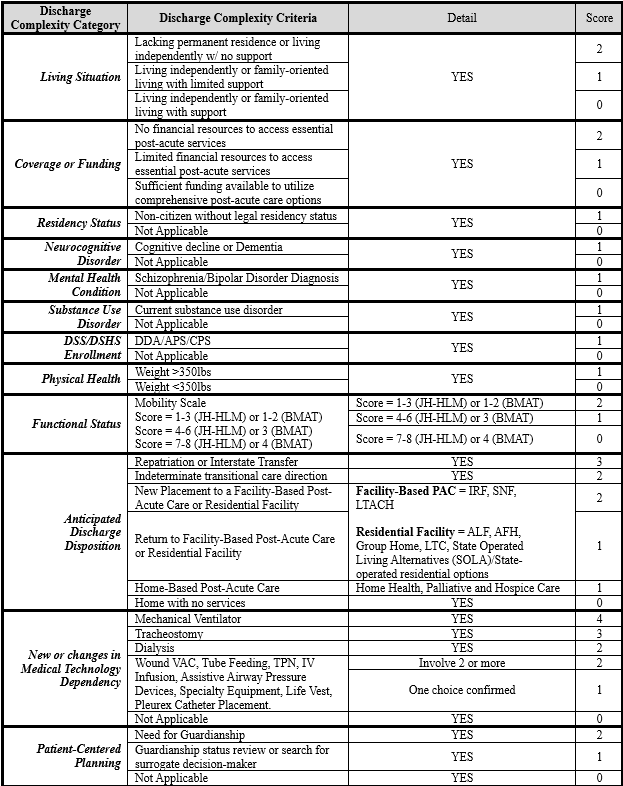
Medical complexity includes factors such as neurocognitive disorders, mental health conditions, substance use disorders, functional limitations, and medical technology dependence. These factors often require specialized resources, additional coordination, caregiver education, and post-acute support services.
Social Complexity
Social complexity considers living situations, support systems, financial resources, residency considerations, and patient-centered planning needs such as guardianship or surrogate decision-making. Even when patients are medically stable, social barriers can significantly delay discharge and increase resource utilization.
System Complexity
System-level factors include payer authorization requirements, state agency involvement, post-acute placement challenges, policy constraints, and multi-sector coordination needs. These barriers often exist outside the direct control of hospital teams but can substantially impact length of stay and discharge outcomes.
Introducing the Discharge Complexity Criteria & Scoring (DCCS) Framework
The Discharge Complexity Criteria & Scoring (DCCS) framework was developed to help Case Managers and Social Workers consistently identify and score discharge complexity across medical, social, and system-related domains. The model provides a data-driven approach that supports daily prioritization, interdisciplinary communication, and proactive discharge planning.
The framework originated from avoidable-day analyses, chart reviews, and frontline operational insights that revealed predictable patterns in discharge delays and complexity. These findings were synthesized into a practical structure that reflects both real-world workflows and measurable performance outcomes.
Matching Resources to Patient Need
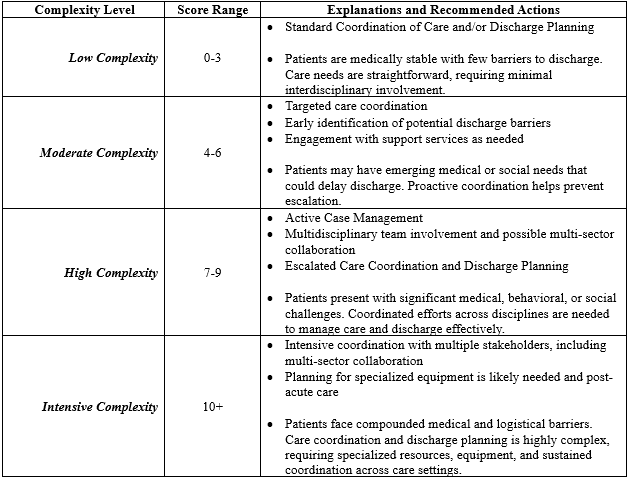
The framework translates complexity into actionable scores categorized as:
- Low Complexity (0–3): Standard discharge planning and care coordination
- Moderate Complexity (4–6): Targeted interventions and early barrier management
- High Complexity (7–9): Active case management with multidisciplinary involvement
- Intensive Complexity (10+): Extensive coordination involving multiple stakeholders and specialized resources
This approach ensures that resources are directed toward patients with the greatest needs while helping teams intervene before barriers escalate into prolonged stays.
Embedding Complexity Into Daily Operations
The greatest value of complexity scoring lies in its integration into routine workflows. The DCCS framework supports:
- Early scoring at admission
- Daily workload prioritization
- Interdisciplinary communication
- Escalation pathways for high-risk cases
- Ongoing monitoring and documentation
- Outcome measurement and performance improvement
Rather than reacting to discharge barriers late in a patient's hospitalization, teams can identify risks within the first 24 to 48 hours and proactively address obstacles before they impact patient progression.
Measuring Impact
Complexity scoring is not simply a clinical tool; it is also an operational strategy. The DCCS framework supports measurement of key performance indicators including:
- Long length-of-stay (LLOS) census
- Avoidable days
- Excess days
- Length of stay
- Medically ready-to-discharge delay days
- Complex case manager workload and caseload complexity
Analysis demonstrated a direct relationship between complexity scores and length of stay. Patients categorized within the intensive complexity tier experienced significantly higher LOS and excess day utilization than those in lower-complexity groups.
Reported outcomes associated with application of the framework included:
- Approximately 18% reduction in LOS
- Approximately 19% reduction in peak LOS
- Significant reductions in long-stay patient populations
- Meaningful reductions in excess days across complexity tiers
Elevating the Practice of Case Management
Complexity scoring moves case management beyond traditional volume-based approaches and toward a more strategic, data-informed model. By standardizing complexity assessment, organizations can better allocate resources, support workforce sustainability, improve interdisciplinary collaboration, and drive measurable improvements in patient flow and discharge performance.
Most importantly, complexity scoring helps organizations understand not only what happened to length of stay and discharge outcomes, but why. That insight allows leaders and frontline teams
Note: Full details and descriptions for each discharge complexity category and scoring criterion are available upon request. We welcome opportunities to share additional information, discuss implementation strategies, and answer questions about the framework. For more information, please contact Edwin Espiritu at eespiritu@ccmspec.com.
Add comment
Comments